

Browse docs
Financial reports and credit liability
Income by class, term and booking type, pending money, refunds, and what your credit book owes.
The financial tab answers the treasurer questions: what came in, what's owed, what went back, and what the club's credit book is worth. Two definitions up front make every number make sense.
Your site may use different words. Tempo lets you rename class, student and teacher under Settings → Branding & vocabulary; these docs use the defaults.
The two definitions
Income is money actually received for confirmed bookings, at the per-booking amounts really paid: after package discounts, after credit. Credit-paid and complimentary bookings legitimately count £0, so counts always sit beside amounts. Transferred bookings' value lives on their destination row (never double-counted), and cancellations live in the credit ledger, not as negative income.
WooCommerce stays the authority on payments. Tempo's reports are the club-shaped view (by class, by term, by package type); the order system is the accounting truth. Order IDs run through every report so the two reconcile line by line.
The reports
- Income, grouped by class, term or booking type; the last is your single-versus-package income split, which is the number that tells you whether package pricing is doing its job.
- Teacher payouts: confirmed income for classes with a payout recipient set on the class, grouped by recipient and class, with the credit-funded share broken out, and, where restricted credit pots are in play, split between the recipient's own pot and school credit (the first is money they already hold; the second is cash the club owes them). For clubs where some teachers are paid per class taught, this is the "what do we owe whom" number.
- Pending payments: unpaid orders with booked value and credit applied, one row per order; this plus the 48-hour pay-by-link flow is your credit control.
- Refunds: every recorded refund from the append-only ledger.
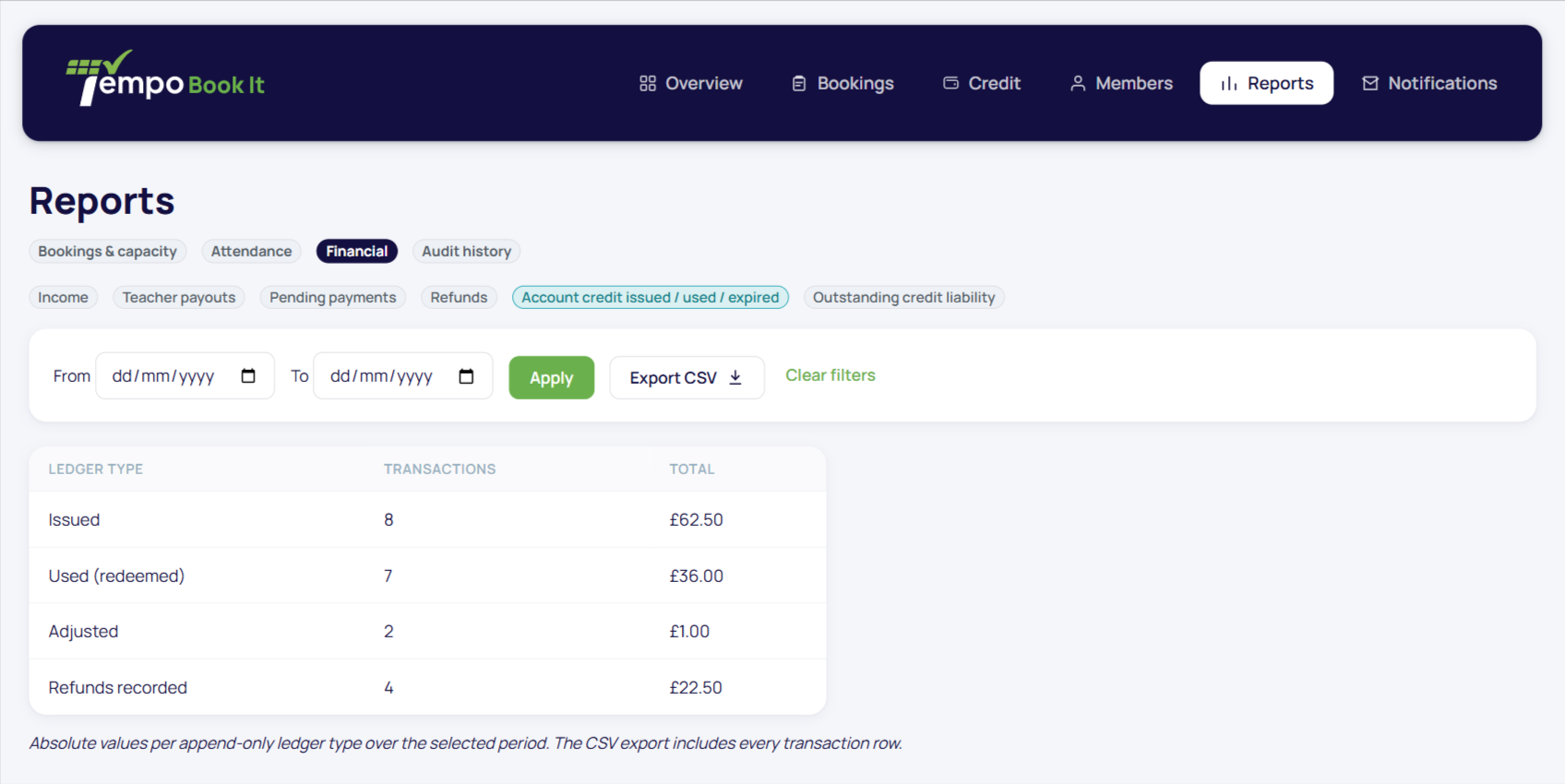
- Credit issued / used / expired: ledger totals per movement type over the period, the money story of your credit system.
- Outstanding credit liability: the sum of remaining value on active, unexpired lots; what the club currently owes families in future bookings. The screen highlights lots expiring within 30 days; the export lists every active lot, and where restricted credit pots are in play the restricted share is shown separately, since that part is honoured by its recipient rather than the club. Accountants ask for exactly this number at year end, and here it is, correct even if the daily expiry job hasn't run yet.
Reading them like an owner
Three habits repay themselves: reconcile income against WooCommerce orders monthly (the IDs make it mechanical); watch the pending report weekly so unpaid never ages into awkward; and glance at liability each term end, because credit is real money you owe, and the report keeps the club honest about it.
Thanks. That helps us improve these guides.
Thanks for letting us know. Ask us on the Support page and we'll help directly.